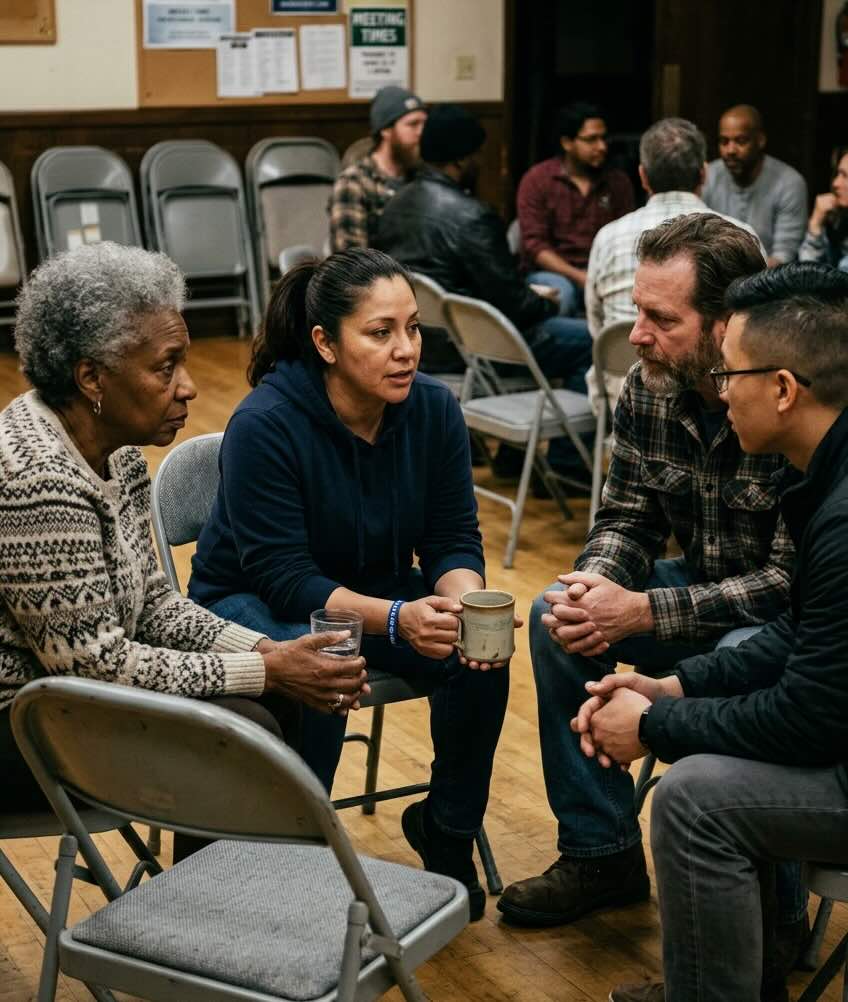
AA meetings come in different formats, and knowing the difference can make your first visit much less uncertain. This page explains every meeting type clearly, so you can walk through the door knowing what to expect.
🔒 Free & Confidential · All 50 States · Available 24/7
Every AA meeting shares the same foundation. They are free, open to people with a desire to stop drinking, and built around honesty and mutual support. What changes from one meeting to another is the format; how time is used, who speaks, and what the group focuses on during that hour.
Knowing the difference between a speaker meeting and a discussion meeting, or between an open and a closed group, helps you choose a starting point that fits how you are feeling right now. There is no wrong choice. Most people try several types before settling into a regular group.
For Your First Visit
An open discussion meeting or a beginners meeting is usually the most comfortable starting point. You can listen, ask questions if you want, and leave without having committed to anything.
Every AA meeting is either open or closed. This is the most important distinction to understand before you search for one.
Open Meeting
Everyone is Welcome
Open meetings welcome anyone, people who are concerned about their drinking, family members, friends, students, healthcare workers, and anyone who is simply curious. You do not need to identify as an alcoholic to attend.
Listed as "Open" or "O" in meeting directories
Closed Meeting
For Those They Need to Stop
Closed meetings are specifically for people who identify as alcoholic or who believe they may have a problem with alcohol. They are more intimate by design.
Listed as "Closed" or "C" in meeting directories
AA groups choose their own format. Most meetings run for 60 minutes. Here is what each format looks like from the inside.
Format
Speaker Meeting
One person shares their personal story, usually following the structure of what it was like, what happened, and what it is like now. The rest of the group listens. There is no back and forth discussion.
Speaker meetings are a good starting point because you can listen without any expectation to participate. Hearing someone else's honest account can be the most clarifying hour of a new member's week.
Format
Discussion Meeting
A topic is introduced: usually a single idea, reading, or question. Members share briefly on it one at a time. No one is required to speak. Sharing is usually two to three minutes per person.
Discussion meetings feel more conversational than speaker meetings. Many people find them easier to participate in once they feel ready to share a few words about their own journey.
Format
Big Book Study
The group reads from Alcoholics Anonymous, the foundational AA text published in 1939. Passages are read aloud, a few paragraphs at a time, and members share what the reading means to them personally.
You do not need to own a copy or have read anything beforehand. Copies are usually available at the meeting for everyone to use.
Format
Beginners Meeting
Beginners meetings are designed specifically for people who are new to AA. They cover the basics of the program, what the 12 Steps mean, and what to expect. Questions are welcomed and expected.
This is often the least intimidating way to experience AA for the first time. Many groups run these alongside their regular meetings.
Format
Step Study Meeting
Each week, the group focuses on one of the 12 Steps in sequence. They read about the specific Step and share their personal experience with it. The group typically cycles through all 12 Steps over several months before starting again.
Step studies are valuable for members who are actively working the program. They tend to be smaller and more consistent than open groups.
Format
12 & 12 Study
Readings come from the book Twelve Steps and Twelve Traditions. This companion text to the Big Book covers both the Steps and the 12 Traditions in greater depth. It offers a more detailed look at the principles behind the program.
Members with some AA experience often find these studies valuable because they explore the reasoning behind each Step in detail.
Format
Candlelight Meeting
These meetings follow a speaker or discussion format but use candlelight instead of overhead lighting. The quieter atmosphere makes sharing feel more personal and the room feel more intimate.
These are usually held in the evening. Some members who struggle to open up in brighter rooms find these environments easier to settle into.
Format
Speaker/Discussion
The meeting begins with a speaker sharing for 20 to 30 minutes, then the floor opens for discussion. Members share on what they heard or what is on their mind.
This combines personal depth with open participation. It is one of the most common formats found in any major US city.
If you are not sure which type of meeting to try first, call 1-888-708-7060. Tell us a little about what you are looking for or just where you are in the country and we will find something that fits. You do not need to have it all figured out before you pick up the phone.
Speak With a Recovery SpecialistFree & Confidential · All 50 States · Available 24/7
Every AA group is open to anyone with a desire to stop drinking. Some groups also choose to focus on a specific community or shared experience. Here is what each one is.
Women-Only Meetings
Open to women only. Many women find it easier to speak honestly in a women-only environment, particularly in early recovery. These groups run in most major cities and many smaller communities.
Listed as "W" in directories
Men-Only Meetings
Open to men only. These groups often have a direct, no-nonsense atmosphere. Some men share differently in a men-only setting than in mixed groups. Available in most cities.
Listed as "M" in directories
LGBTQ+ Welcoming Meetings
Some groups specifically identify themselves as welcoming to LGBTQ+ members. All AA meetings are open to everyone, but these groups have a culture built with LGBTQ+ experiences in mind. Common in cities like West Hollywood, San Francisco, and Chicago.
Listed as "LGBTQ" or "Gay/Lesbian" in directories
Young People's Meetings
Focused on younger members, typically under 30, though anyone is usually welcome. The conversation tends to center on concerns specific to early adult life: relationships, career, family, and getting sober before having decades of drinking history.
Listed as "YP" or "Young People" in directories
Spanish-Language Meetings
Conducted entirely in Spanish. Available in large numbers across cities like Miami, Houston, Los Angeles, New York, and Chicago. Bilingual meetings, where both English and Spanish are spoken, are also listed in many directories.
Listed as "S" or "Spanish" in directories
Secular / Agnostic Meetings
These groups follow AA core principles but adapt the language around spirituality to be more accessible to non-religious members, agnostics, and atheists. The 12 Steps are still central, but references to God are not required. Growing in availability across most major US cities.
Listed as "Secular" or "Agnostic/Atheist" in directories
Online AA meetings follow the same formats as in-person meetings. They are free, open to anyone in the US, and available around the clock. You do not need to turn your camera on. Many people attend online meetings for months before transitioning to an in-person group, and some members prefer online permanently.
Online meetings became widely available after 2020 and are now a permanent part of AA. The experience is different from sitting in a room with people, but for someone who is not yet ready to walk through a door, an online meeting is a real meeting that counts.
Everyone's situation is a little different. Here are four common starting points depending on where you are right now.
If you want to listen before saying anything
Start with a Speaker Meeting
One person speaks and the group listens. Nobody will ask you to share. You can simply sit and hear someone else's honest account of where alcohol took them and how they found their way out.
If you are completely new to AA
Look for a Beginners Meeting
Beginners meetings are built around the questions that new people have. You can ask anything. Nobody expects you to know the language or the program. This is genuinely where many people start.
If you are not ready to walk into a room yet
Join an Online Meeting First
Online meetings are real meetings. They count. If you want to hear what AA sounds like before showing up somewhere in person, attending a Zoom meeting is a completely legitimate starting point.
If you are already in AA and want to go deeper
Try a Big Book or Step Study
If you have been attending open discussion meetings but want something more focused on actually working the program, a Big Book study or Step study group gives you a structured progression.
If you are not sure which type of meeting to try first, call 1-888-708-7060. Tell us a little about what you are looking for or just where you are in the country and we will find something that fits. You do not need to have it figured out before you pick up the phone.
📞 1-888-708-7060Free & Confidential · All 50 States · Available 24/7
"I went to an open speaker meeting my first week. I did not say a word. I just sat in the back and listened to a man talk about his life. By the end I was crying. I went back the next day."

Patricia W.
11 years sober · Columbus, Ohio
Does it matter which type of meeting I go to first?
No. Any meeting you walk into is a good meeting to start with. The most important thing is that you go. Most people find their preferred meeting format after trying a few different types, and that process usually takes just a few weeks.
How do I know if a meeting is open or closed before I go?
Meeting directories, including our state and city pages, list each meeting as open or closed. In printed schedules, open meetings are marked "O" and closed meetings are marked "C." If you are ever unsure, call 1-888-708-7060 and we will confirm the format before you go.
Can I attend a women-only or men-only meeting if I am non-binary or transgender?
Individual groups handle this differently. Many women-only and men-only groups are welcoming to transgender and non-binary members, particularly in larger cities. If this is a concern, calling ahead is the simplest way to find a group that will be comfortable for you. Our helpline can help identify a specifically welcoming group in your area.
Are Big Book and Step study meetings for beginners?
They are open to everyone, including newcomers. However, most beginners find discussion or speaker meetings more accessible as a starting point because they do not require any prior knowledge of AA's literature. Step and Big Book studies become more valuable once you have a basic familiarity with the program.
Are online meetings as effective as in-person meetings?
Many people find online meetings genuinely helpful, and attending them regularly does build recovery. In-person meetings tend to offer more of the community element, the coffee afterward, the phone numbers, the relationships that develop over time. Both have real value, and online meetings are a legitimate place to start for anyone who is not yet ready to walk through a door.
What does "speaker lead" mean in a meeting listing?
A speaker lead meeting is a discussion meeting that begins with a short speaker sharing for 10 to 15 minutes to set a theme or tone. It is different from a full speaker meeting, where one person speaks for most of the hour. After the lead, the floor opens for general sharing from anyone in the group.

Browse our directory by state and city, or call us and we will find a meeting in your area today — whatever type feels right for where you are right now.
Free & Confidential · Available 24/7 · All 50 States
Related Pages
Joined by 3 million+ people in recovery worldwide
You don't have to figure this out alone. Our team is available around the clock to connect you with a free AA or NA meeting, answer your questions with zero judgment, and support your recovery journey, one day at a time.
📞 1-888-708-7060Available 24/7 · Free & Confidential · No Obligation