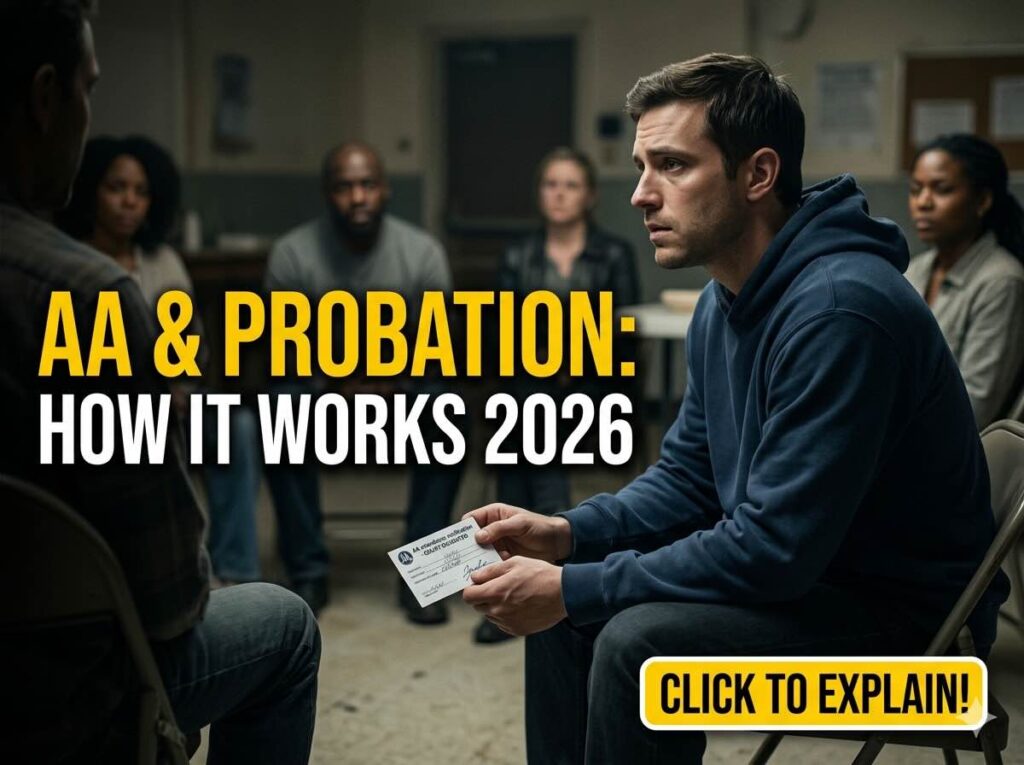
Court-ordered AA attendance is one of the most common probation conditions attached to DUI convictions, alcohol-related offenses, and drug cases across the United States. When a judge includes it in your sentence, attendance becomes a legal obligation enforced by your probation officer. Missing meetings, submitting incomplete documentation, or misunderstanding what counts as valid attendance can trigger a probation violation and revocation.
This guide explains exactly how court-ordered AA attendance works in practice: how attendance is verified, what your probation officer expects, whether virtual meetings satisfy the requirement, what your legal rights are, and what mistakes most commonly cause avoidable violations.
AA on Probation: Key Facts
- Who orders it: Judges and probation officers, typically in DUI, alcohol-related, and drug cases as a condition of probation or alternative sentencing
- How attendance is verified: A court-issued attendance slip signed by the AA group secretary or chairperson at each meeting, submitted to your probation officer on a set schedule
- Does AA have to sign slips: No. Each AA group decides independently by group conscience whether to sign court attendance documentation. Most do, but some decline. Confirm before relying on any specific group
- Virtual meetings: Accepted by some probation departments, not by others. Confirmation in writing from your probation officer is required before substituting virtual attendance for in-person meetings
- Consequences of non-compliance: Missing court-ordered AA attendance is a probation violation and can result in revocation and incarceration
- Alternatives to AA: In some jurisdictions, secular programs including SMART Recovery are accepted alternatives. Courts have been successfully challenged on First Amendment grounds for requiring exclusively AA attendance
- Cost: AA meetings are free. No membership, no registration, no fees
What Court-Ordered AA Attendance Actually Means
Courts have ordered AA attendance as a probation condition since the 1940s, primarily in alcohol and drug-related cases. The rationale is structured, verifiable accountability: a regular commitment to a recovery-oriented program that your probation officer can confirm through documentation.
Understanding the relationship between the court system and AA is important for compliance. AA is an independent, nonprofessional organization. It operates through voluntary participation and self-governance at the group level. AA does not coordinate with courts or probation departments, does not track attendance on behalf of law enforcement, and has no formal obligation to facilitate your legal requirements. The individual AA group you attend decides, through its own group conscience process, whether and how it will accommodate court attendance documentation. Most groups accommodate it; some do not.
Your probation order specifies the exact requirement: number of meetings per week, how long the requirement lasts, and what documentation you must submit. Read your probation order carefully. Keep a copy. Every question about compliance starts there, and your probation officer is your primary point of contact for anything the order does not make clear.
How Attendance Is Documented and Verified
The standard documentation process works as follows. Your probation officer provides court attendance slips, typically printed forms that include your name, case number, the date of the meeting, the meeting name and location, and a signature line. You bring the slip to the meeting, attend from start to finish, and at the close of the meeting, ask the group secretary or chairperson to sign and date it. Many groups also use a rubber stamp with the group’s name for additional verification.
Completed slips are submitted to your probation officer on the schedule specified in your probation order. Some officers require weekly submission; others collect slips at monthly check-ins. Follow the schedule exactly. Late submission is a compliance issue regardless of whether you attended.
Keep a personal copy of every signed slip before submitting originals. Slips can be lost in transit, misplaced at a probation office, or disputed. Your own records protect you if a question arises later. Some people photograph each completed slip before submission as a straightforward backup.
What Happens at an AA Meeting
AA meetings follow a consistent structure, though specific format varies by group. Most meetings open with the AA Preamble read aloud, followed by readings from AA literature, typically selections from the Big Book or the Twelve Steps and Twelve Traditions. The chairperson then opens the floor for sharing, where members speak voluntarily about their experience with alcohol and their recovery. Attendance does not require participation. You can sit, listen, and say nothing. No one will call on you or require you to introduce yourself.
Meetings fall into two categories. Open meetings welcome anyone, including people attending under court order, family members, and those exploring whether AA is relevant to their situation. Closed meetings are intended for people who identify as having a problem with alcohol. If you are attending under a court order and are uncertain about your relationship with alcohol, start with open meetings. A closed meeting chairperson may ask whether you identify as having a problem with alcohol before permitting attendance.
Confidentiality is foundational to AA. What members share in a meeting remains within the meeting. The group secretary or chairperson signing your attendance slip confirms your presence at the meeting. It communicates nothing about what was said or what you did while there.
Do Virtual AA Meetings Count for Probation?
Virtual AA meetings expanded significantly during the COVID-19 pandemic, and many courts temporarily accepted online attendance when in-person meetings were closed. Some jurisdictions formalized that acceptance; others returned to requiring in-person attendance once meetings resumed. The result is that there is no universal standard. Whether virtual meetings satisfy your probation requirement depends entirely on your specific probation order and what your probation officer will accept.
Some online AA groups provide formal attendance verification documents for people with court-ordered requirements. Online Group AA is one established example, offering documentation that records meeting name, date, platform, and the attending member’s name in a format designed for court and probation submission. Whether your probation officer accepts this documentation is a separate question that requires direct confirmation.
Before attending any virtual meeting and counting it toward your requirement, ask your probation officer whether online attendance is acceptable, what documentation they require, and whether any specific platforms or groups are approved. Request that confirmation in writing, whether by email or written note in your file. A verbal agreement that is later disputed leaves you without protection. Written confirmation eliminates ambiguity.
If your probation order was written before virtual meetings were common and does not address them, request a formal clarification from your probation officer or attorney before making any assumption about what counts.
Your Legal Rights Around Court-Ordered AA
Courts have faced legal challenges to mandatory AA attendance on First Amendment grounds. Because AA incorporates references to a higher power and is structured around spiritual principles, some courts have ruled that requiring participation without offering secular alternatives constitutes forced involvement in a religious activity.
In Warner v. Orange County Department of Probation, the Second Circuit Court of Appeals found that requiring a probationer to attend AA, without providing secular alternatives, violated the Establishment Clause of the First Amendment. The court recognized that the coercive nature of probation conditions, where non-compliance means potential incarceration, constituted state compulsion to participate in religious activity.
SMART Recovery maintains documentation of court cases addressing mandated 12-step attendance and works with courts to establish acceptance of its secular, evidence-based program as an alternative. If you have genuine religious or philosophical objections to AA’s framework, you may have legal standing to request an alternative such as SMART Recovery, LifeRing Secular Recovery, or Secular Organizations for Sobriety. Raise this issue through your attorney and through proper legal channels before any action that could be interpreted as non-compliance with your current conditions.
Mistakes That Cause Avoidable Probation Violations
The majority of probation violations related to AA attendance follow predictable patterns. Knowing them in advance prevents them.
- Attending a group that does not sign court slips – Call ahead or ask at the door before relying on any specific meeting location. Groups that decline to sign will tell you directly, and you need to know before leaving without documentation
- Substituting virtual attendance without confirmation – Attending online meetings without written approval from your probation officer creates a compliance gap that cannot be corrected after the fact
- Arriving late or leaving early – Full attendance is required for documentation to be valid. Partial attendance will not be signed and does not count toward your requirement
- Submitting originals without keeping copies – Keep a copy or photograph of every signed slip before it leaves your possession. Loss or dispute of a slip leaves you without proof of attendance
- Falling behind and catching up in clusters – Attempting to attend multiple meetings in a single day or week to compensate for missed weeks is a recognizable compliance pattern. Address scheduling problems with your probation officer before they become violations
- Assuming NA meetings satisfy an AA requirement – Many probation orders specify AA or NA interchangeably, but some specify AA only. Verify what your order states and confirm with your probation officer before substituting one for the other
How to Find AA Meetings Near You
The Sober.now AA meeting finder at our website lists in-person meetings by location across the United States and internationally. Listings include meeting name, address, schedule, meeting type (open or closed), and in many cases whether the group accommodates court-ordered attendance. Filtering for open meetings is the safest starting approach when attending under a court order for the first time.
For virtual meetings, Online Group AA maintains a schedule of online meetings and provides attendance documentation for people with court requirements. The AA Intergroup online meeting directory also lists virtual meetings across multiple platforms including Zoom and telephone.
If you are in a geographic area with limited local meeting options, document this limitation and discuss it with your probation officer directly. Geographic hardship is a legitimate basis for requesting approval of virtual attendance and should be raised proactively rather than used as an after-the-fact explanation for missed meetings.
California Courts Accept Online AA Meetings for Diversion & Probation
As of 2026, California courts widely accept online AA meetings for fulfilling court-ordered requirements under Penal Code 1000 (Drug Diversion) and PC 1001.36 (Mental Health Diversion). Recent 2026 legislative updates, including Assembly Bill 46, have reinforced judicial discretion, but they also demand “robust treatment plans.” This means that while virtual meetings are accepted, they must be part of a structured, verifiable program.
Acceptance typically depends on whether the meeting is interactive. Most California jurisdictions, from Los Angeles to Sacramento, distinguish between “passive” recovery (watching videos) and “active” recovery (participating in live Zoom or digital rooms). To satisfy your probation or diversion terms, ensure the meeting is recognized by your county’s alcohol and drug program administrator and allows for real-time engagement.
How to Prove AA Meeting Attendance for California Court Diversion
Securing proof of AA meeting attendance for a California court or probation officer has become more standardized in 2026. To meet the “observed reliability” standards expected by judges, you must provide documentation that goes beyond a simple self-report. Use these verified methods:
- Digital Verification Systems (Pathcheck): Many online groups now use Pathcheck or similar QR-coded systems. You log in, enter a unique meeting code provided by the chairperson, and an instant, time-stamped verification is emailed to you and your Probation Officer (PO).
- Electronic Attendance Slips (PDF): At the end of a Zoom meeting, the Secretary will often provide a digital signature or a “signed” PDF attendance slip. Ensure this document includes the meeting’s unique ID number and the Secretary’s contact information for court spot-checks.
- Visual Watch Lists: For ongoing diversion programs, some groups (like Any Lengths) maintain a “visual watch list.” By attending regularly and turning on your camera, the host can visually confirm your presence and provide a formal Proof of Attendance (POA) letter after a set number of sessions.
- Screen Identity Protocol: Always set your Zoom or platform display name to your First Name and Last Initial (e.g., John D.). Courts may reject proof if your screen name appears as “iPhone” or a generic pseudonym.
Pro Tip: If you are using online meetings to satisfy a DUI or drug diversion, check your “Minute Order” from the court. If it explicitly requires “in-person only,” you must file a motion to allow for remote appearance before switching to digital meetings.
What the Research Shows About Court-Ordered AA Attendance
The effectiveness of court-mandated 12-step attendance is a subject of ongoing research. Studies consistently distinguish between voluntary AA participation, which is associated with positive recovery outcomes, and coerced attendance, where outcomes are more variable. Research published in Alcoholism: Clinical and Experimental Research found that motivation for attendance significantly moderates its effectiveness, with internally motivated participants showing stronger outcomes than those attending exclusively under legal compulsion.
A Cochrane Collaboration systematic review of AA and 12-step facilitation interventions found that AA participation was associated with higher rates of continuous abstinence compared to other interventions across multiple studies, but noted that the evidence base for court-mandated specifically, as opposed to voluntary, participation is less well-established.
What this means practically: attending AA because a court requires it does not produce the same outcomes as attending because you have decided you need it. The legal obligation gets you in the room. What happens after that depends on engagement that no court order can mandate.
Frequently Asked Questions
Will my probation officer know if I miss an AA meeting?
Your probation officer knows when you fail to submit the required attendance documentation. AA groups do not report to probation departments, so there is no direct notification of a missed meeting. The evidence of non-attendance is absent documentation at your required submission intervals. Falsifying attendance slips is a separate criminal offense with consequences beyond the original probation violation.
Can an AA group refuse to sign my court slip?
Yes. AA groups are autonomous and decide by group conscience whether to sign court attendance documentation. Some groups decline on the basis that doing so falls outside AA’s traditions or creates a relationship with outside entities that the group does not endorse. When a group declines, find one that will sign. Never present unsigned documentation as completed attendance.
Do I have to speak or introduce myself at AA meetings?
No. Participation is entirely voluntary. You can attend every meeting, say nothing, and your attendance is fully valid. Many people court-ordered to attend AA sit and listen for months before choosing to speak. There is no participation requirement for documentation purposes.
Can I attend NA meetings instead of AA?
Many probation orders specify AA or NA attendance interchangeably. Some specify AA only. Check your probation order first. If it specifies AA, get written confirmation from your probation officer before substituting NA attendance. Do not assume interchangeability without verification.
What happens if I move or travel and cannot access my regular meetings?
AA has meetings in virtually every city and town in the United States and in over 180 countries. The aa.org meeting finder covers most locations. If you relocate or travel, find local meetings and continue documentation. Notify your probation officer of any address changes as required by your probation conditions.
Can consistent AA attendance help with sentence reduction or early probation termination?
Documented, consistent compliance with all probation conditions, including AA attendance, strengthens any petition for early termination or sentence modification. Judges have discretion to view consistent AA participation as evidence of rehabilitation. This outcome is not automatic and is best pursued through your attorney, but your attendance record is part of the case your attorney can make on your behalf.
What is the difference between AA and SMART Recovery for probation purposes?
AA is a 12-step, spiritually-oriented peer support program. SMART Recovery is a secular, evidence-based program using cognitive behavioral and motivational techniques without spiritual components. Courts in many jurisdictions accept both; some specify AA. If you prefer SMART Recovery for religious or philosophical reasons, confirm whether your jurisdiction accepts it and raise the issue through your attorney if the court order specifies AA only. SMART Recovery’s court cases page provides documentation to support that request.
References
- Alcoholics Anonymous – Official Meeting Finder
- Online Group AA – Attendance Proof for Court-Ordered Requirements
- AA Intergroup – Online Meeting Directory
- SMART Recovery – Court Cases and Mandated 12-Step Attendance
- PMC – Alcoholism: Clinical and Experimental Research – Motivation and AA Outcomes
- Cochrane Library – Alcoholics Anonymous and Other 12-Step Programs for Alcohol Use Disorder (2020)
- AVVO – How Will My Probation Officer Know if I Attended AA?